Tech-Driven Spaces: The Evolution of Coworking with Geoff Wood
BTSH Geoff Wood
===
[00:00:00]
Joshua McNary: Welcome to the BizTech Superhero, the podcast that empowers you to unleash the technology superpowers within your business. I'm your host, Joshua McNary.
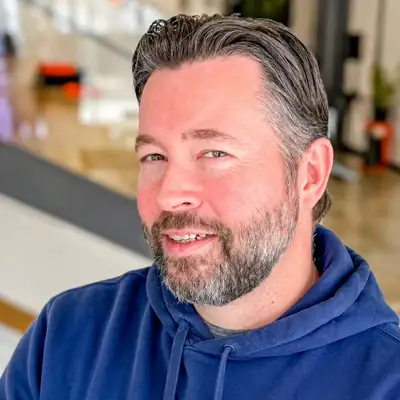
Joshua McNary: I'm joined by today's superhero, Geoff Wood, founder of Gravitate Coworking based in Des Moines, Iowa. He is a longtime community builder focusing on entrepreneurs, freelancers, remote workers, and startups.
Joshua McNary: Geoff's career has really unfolded in three chapters. After studying community planning and later earning an MBA, he spent his first decade consulting with local governments around the country. His second decade was focused on helping build Iowa's startup and entrepreneurial community. Today, he's putting those experiences together through Gravitate Coworking, my own company offices at the Gravitate Cedar Rapids location
Joshua McNary: I'm a longtime co-worker myself and a big fan of the concept. Geoff is building these places and communities where people can have a real impact [00:01:00] on their ability to build, work, and succeed through a sense of place, networking, accountability, and belonging.
Joshua McNary: Today, we'll talk about co-working, entrepreneurship, and what it takes to intentionally build community in a world where technology has given us more flexibility in where we can work and how we work, but perhaps made meaningful connection even more important.
Joshua McNary: Geoff, welcome to the show.
Geoff Wood: Thanks, Josh. Happy to be here
Joshua McNary: So for folks just meeting you for the first time, could you share a little bit more about who you are and what you do?
Geoff Wood: As you said, my name is Geoff. I've been in the coworking industry, I think we've had the company 13 years now. And then some of the other things I did before this I was a member at coworking spaces or kinda quasi coworking spaces, so have been around it a long time.
Geoff Wood: Originally started the company because the coworking space I was working at had some grant funding, and the grant was ending, and they had said they had a meeting of the members and said "What do we need next after this coworking [00:02:00] space goes away?" And what I heard from people in that room was, "We need high density, low priced office space.
Geoff Wood: We need a community center to have things like lunch and learns," and if you know what 1 Million Cups is. And then we need a front door to the entrepreneurship community so that people that wanna get started have a place physically to go to find out information when they either come to Des Moines or if they've been in say, the insurance industry in Des Moines for 20 years and now they wanna start a business, like, where do we start?
Geoff Wood: So I heard all those things and I wrote a blog post that was called What Des Moines Needs Next is an Entrepreneurial Center of Gravity. And, 13 years later, that entrepreneurial center of gravity is called Gravitate Coworking, and that's not coincidence that those names are similar.
Geoff Wood: One of our members came up with that, and have kinda just been running with it ever since.
Joshua McNary: That's a great origin of the story, and it reminds me of back when I started my businesses. I got launched in the beginning of 2014, so around the same timeframe you're talking about, and going to, back then I think they were called jellies. Is that the term? What... Yeah, it was like
Geoff Wood: that's an old school coworking
Joshua McNary: That's an old-school cor- I don't even know why [00:03:00] exactly that... What was it? You were mashing up or s- I don't know what even the terminology was for. But I remember going to some of those here in Cedar Rapids in that same timeframe
Geoff Wood: Yeah and for those that don't remember Jellies, the idea was like co-working but without a co-working space. So a lot of times you'd meet at the library or at a bar. It's like, "I'm gonna be working here today. Who wants to come work with me?" And we've done that in the past when we're looking at new parts of town we wanna expand into is let's see who we get if we do one here, and let's see ~if we do...~
Geoff Wood: ~who we get ~if we do one on the other side of town, and try to find where our cust- potential customers are. So yeah, that's real old school
Joshua McNary: Yeah, that's the right way to do it as a startup and small business, right? Is you go beta test what you're doing by, let's just go meet in a random room, see if we can build a business here. And that's, ... But I remember doing those here in Cedar Rapids back, way back in that timeframe.
Joshua McNary: This is yeah, basically the same timeframe you were getting going, it sounds Ed, and then end up joining the coworking space that was here the predecessor to what is now Gravitate Coworking in Cedar Rapids here. And have been part of that for a long time. So I really appreciate what you're doing, and also enjoyed going both [00:04:00] to your locations in Des Moines as well as other places across the country, and other coworking facilities because I find it's a, just an amazing place to meet other people that are trying innovative things, doing new things.
Joshua McNary: With my work, it's a place to mingle with people that maybe I could work with or partner with or just find that energy
Geoff Wood: Yeah, it really is. And sometimes you just need a professional space to work when you're traveling too, so that's nice. We're part of a reciprocity network where our members can travel all over the world really, but around the US to do that. But I will often do that even if I'm traveling with family and it's just like I need to get out of this hotel room for four hours and get some work done and be in a place that feels like I'm working so I can actually concentrate on it.
Joshua McNary: That sense of place is really important. I've, over the years, taught or told people shifting your physical place can be such a unlock, at least for my diagnosed ADHD or whatever's going on in my head, how I think about moving from place to help me refocus and say, "Okay, at this place I'm doing this [00:05:00] thing.
Joshua McNary: At this place I'm gonna do this thing," or create rhythms in your life by doing that. And the co-working s- facility is part of that. That's how I use my office at Gravitate Cedar Rapids in a capacity. There are certain days, and then I'm at home where I'm recording this right now in my home office, and then sometimes I go to the coffee shop or other places
Geoff Wood: Yep, I do the same. And I remember a psychology study years ago, and I can't really credit where it is, but they had said even if you are gonna work from home, you should still make yourself wake up at the time you would wake up to come to the office and take a walk around the block so that you shift from what your morning life was at home, and when you come back, it's like you ~walked in the door to your house, and then you're in that...~
Geoff Wood: ~Or ~walked in the door to your office, so now you're in that sort of work mode even though all you did was walk around the block and come back to the same place.
Joshua McNary: You're not here to be my mental health help today but that kind of thing is some of the stuff I'm actually doing right now, as we're coming into the fall season, and that's obviously work season here in, in northern hemisphere anyways, we're thinking about work.
Joshua McNary: So the idea of resetting those rhythms, and I like the idea of, yeah, getting back up at the same time every day. Don't [00:06:00] get lazy on us. I think coming out of the whole, now a number of years ago, but the pandemic lockdowns and all the, how that shook everything up we're starting to find that those rhythms that maybe we had before, like getting up and going to the co-working space are coming back.
Geoff Wood: Yeah, absolutely
Joshua McNary: So let's bring this back to the technology since we are on the BizTech Superhero here. What are the angles here that is empowering that what you're able to do at Gravitate, what coworking can do for business people of all stripes, is the fact that the technology allows us to do that. Most of us are knowledge workers that are using these types of facilities.
Joshua McNary: But the ability for us to move around and connect to the cloud or connect to our company, even if it is a, brick-and-mortar organization that we're able to remotely work or be nomads or those, all these terms that come up around this concept.
Joshua McNary: Can you talk a little bit about what you've seen with that and kinda how that has evolved during the last 10, 15 years as you've been on this journey?
Geoff Wood: Yeah, how the technology of our users has evolved,
Joshua McNary: Yeah, like how that [00:07:00] enables and allows you to even have a business
Geoff Wood: We have been around for 13 years, but we grew substantially during the pandemic. And so kinda what started as a, what I would say that entrepreneurial center of gravity, as I mentioned before, that idea that entrepreneurs need a place to get started.
Geoff Wood: They need a place to I have an idea, what... i'm gonna set my laptop down and get to work. That was good for us, and that was the area I was working in before I started this. But that was tough for us to grow because Iowa is a small state, and just the, the number of entrepreneurs starting per day or month or year is not the frequency that we would need to really grow the company into what it is today.
Geoff Wood: So when the pandemic happened we boomed a lot 'cause so many people were able to break that tie between working in the corporate office and having the job that they wanted. So all of a sudden, the corporate office may be in Chicago or New York or London, but you could still live in Des Moines if that was where you wanted to be.
Geoff Wood: So those people were often, remote employees or work from home employees or whatever, and just found, as we've kinda said that's not an ideal place [00:08:00] to be every day. So with those remote technologies, like being able to come into a co-working space and have a group, a community of people to walk to the coffee shop with to grab lunch, that type of thing has really been the type of thing that has helped fuel our growth and where we see more cities.
Geoff Wood: And we have the opportunity to have a lot more gravitates than we do. I think people don't realize how capital-intensive co-working spaces are, but we have to lease, remodel, buy furniture, things like that, so we can't grow as fast as we'd like. But as we have grown, it's because the people that are using technologies like Zoom, like Slack, like all of the remote technologies, has been, like, a good fuel of work space members to come to us in that time.
Geoff Wood: I was trying to think of what is the actual changes in technology we've seen. We did have to increase our bandwidth when so many people started on Zoom because we just weren't used to having 30 people all concurrently on Zoom calls at the same time pre-pandemic.
Joshua McNary: Zoom was a thing before I was using Zoom back then, but it was such a niche thing, it, became [00:09:00] commonplace, right? And not just that, video in general has really boomed over the last 10 years
Geoff Wood: We have a member who's been a member with us, I think all 13 years, or certainly most of that time who worked for a company called Squiggle. Do you remember that technology? But it was a, the idea was remote technology software, so it was like pre-Zoom, but it would just ha- you'd have your camera on, and you'd see your whole team on there, and it would just take a photo of you every 30 seconds.
Geoff Wood: So you could see who was working, but it wasn't like live streamed. And the idea was like, "These are my coworkers, so I can see them even though that I'm remote." So it's funny to see how far we've come in that time from things like that we're trying to get there to like everybody has Zoom or Teams or the Google version, I don't even know what it's called, Meet, Google Meet, that type of thing.
Geoff Wood: So we have to be able to have bandwidth and network to have so many concurrent streams going on, at all the time. But for the most part, I would say that's the main like technology change that we had to make during that time. We've implemented a lot of technology by choice since then, but that was the big change.
Joshua McNary: I definitely wanna ask you more about some of those technologies you're using to understand what's [00:10:00] happening in your world. But before we get to that I think this idea was it Squiggle you said was the technology? It reminds me as well going back to be a a original coworker I guess in the, or in the aughts and in the teens of our, of this of the '20s.
Joshua McNary: The idea of
Joshua McNary: These technologies that enable or help create community of some form, which is what you're alluding to. I remember we had at The Vault Coworking, which was the predecessor to the Gravitate in Cedar Rapids, way back in the very early days, we had some kind of like jukebox tool that we used that allowed us to request songs, and then we all were listening to them like on our individual devices, and it was...
Joshua McNary: I don't remember what it was called, but it was a fun tool that we were able to create some community around.
Geoff Wood: Was it turntable.fm?
Joshua McNary: It might've been.
Geoff Wood: You see little DJs in the window
Joshua McNary: I feel like I did. Yeah,
Geoff Wood: Yeah. That was before Gravitate, but yeah, we used- that was big. You'd get a group of people in a room and you'd have a queue of music
Geoff Wood: but yeah, I feel like that was one of the startups that was a lot of fun to play with and nobody ever
Joshua McNary: There was no business model, right?
Geoff Wood: so there was no business. [00:11:00] Yeah.
Joshua McNary: yeah. That, and then you see this also in the event planning space. I've seen these tools that are essentially like virtual rooms, right? You could go to this meetup or go to this thing. But there's been versions of that for co-working or, placemaking concepts like this.
Joshua McNary: Maybe you can talk a bit about those tools and then lead into what you are using a little bit.
Geoff Wood: Yeah, and we never really used those. 'Cause Zoom conferencing has that, right? Where you can have a subset of people that break out into a room and then come back together for a plenary session type of thing. We've never really experimented with that. I do know a lot of co-working spaces because during COVID the exact thing that we want to do, the value we bring of putting people in close proximity to each other, obviously was not healthy during COVID.
Geoff Wood: So there was a lot of pivoting and trying- during COVID. So there, there were several companies I know that tried to do online kind of cohorts of, like we said everybody just be on Zoom. I think the closest we got to that was trying to do Zoom happy hours, like once a week.
Geoff Wood: Everybody grab a drink and sit on your porch or whatever. And those are fun to see everybody, but one person just talks over the other those didn't last all that [00:12:00] long. No, the, the technology we use today is really, we have a core operating system, for Gravitate.
Geoff Wood: It- there's lots of names for this technology, but the one we use is from a, a Canadian company called Optix. But that is our billing platform, that is our booking platform for people to book out phone booths like I'm in right now or to book out conference rooms. Scheduling, all of that kind of happens in one place.
Geoff Wood: And, in the early days of Gravitate, I billed everybody individually using Wave. Do you remember the Wave? I don't know if that's still around. But before I needed, like, full QuickBooks, which is the technology that I pay the most for that I hate is QuickBooks. I just can't get away from it 'cause it's got all the data stored, but they always raise rates on me and tell me all these things that they're bringing me, and I'm like, "I just want it to work the way it always does.
Geoff Wood: Stop doing this." But yeah, so I used Wave. I would bill people individually on Wave, and then we had a separate conference room scheduling. We had hard keys for people to get in. We- I would go make copies of keys for people to get in to the office. And now we do all of that in that Optix software, including the access management.
Geoff Wood: So we have electronic door locks on all the Gravitates, and [00:13:00] so you as a member, as long as your membership is valid, have the ability to unlock any of the doors, whether you're coming to the space you knew normally in Cedar Rapids or, like you said, if you're in Des Moines for the day, you can unlock the Des Moines door and come in and book a conference room here.
Geoff Wood: It's all one integrated package. And it's not inexpensive for us. There are cheaper versions of that in the co-working world, but it's really the one that we think has the best experience. So we pay... We're willing to pay more and have it a branded experience. So it's a Gravitate app, not the app that the company puts out there, which is what we had before.
Geoff Wood: It was, you had to log into that company's app and then select Gravitate from the list of companies. This is our app. It gives you all those things, sometimes I hate it because we have to do a lot of, we'll go back and forth with support over things that I want it to do, but they haven't built yet, those types of things.
Geoff Wood: But for the most part, it's been really great software, and I recommend it to any co-working provider.
Joshua McNary: Category do they call this? What would it be? It's an ERP of sort for your industry. What do they call themselves?
Geoff Wood: I would call it's like our operating system. I think they probably put some sort of like management tool, like co-working management software. We have used five of those, I think, in the life of the [00:14:00] company. Two of them have gone away spontaneously.
Geoff Wood: I just get an email and they're like, "Hey, company doesn't exist anymore." So I don't know that there's a great answer to what category is it, 'cause I think the category is pretty niche. And that's what I think why some of them go away is that they just can't sign up enough customers to keep building the software that they want to.
Geoff Wood: The one that we recently left that we were on for a long time they were experiencing that, but they wouldn't tell us about it. So they were trying to build like facilities management software, and so like our rates would increase, but we wouldn't get any new features or things we're asking for, 'cause I think what was happening is they were charging us more to try to build this other software for a bigger industry.
Geoff Wood: And so finally, that's was kinda one of the reasons we left that, and then we found this one that, that we really liked. I don't know that there's a great answer to what it is as far as industry.
Joshua McNary: I'm glad I asked though, because then you started talking about the other ones, which is great. That's good context for anybody that's listening, even if you have nothing to do with facilities or co-working or whatever, right? Because you've been at this long enough, you're innovative enough to try things, and you're not afraid to try [00:15:00] startups or smaller companies and explore things.
Joshua McNary: But ultimately, you have people that ghosted you, and then you had others that just weren't a good fit anymore, and then you moved on to something else. And this is a common story that we hear in technology over and over again, whether it's a small piece of your overall profile, a technology in your business, or, the whole thing that runs the business, which is what this tool is doing for you.
Joshua McNary: And that's why it's so critical that you have it right and you're comfortable with the company you're partnered with.
Geoff Wood: And I guess something that's scary about where we are with this right now is there is a company called Yardi. I don't know if you've ever heard of that, Y-A-R-D-I. Which is I think it's Mr. Yardi's company. I think the founder's name is Yardi, where that comes from. They're out of Santa Barbara.
Geoff Wood: They are buying everything in the real estate management space. They're rolling up everything. So like we're on several different, like we call them aggregator platforms. So it's like if you're just in a, say you're in Chicago tomorrow, and you're just like, "I want a co-working space," you can go like, like the Zillow-type things for co-working spaces to find a space to book.
Geoff Wood: Like Yardi has bought all of them. They bought WeWork, [00:16:00] if you remember WeWork the company, like, 'cause they were providing the software for WeWork, so they now own that. It's like I often have some piece of technology that we have a contract with, and I'll get an email that says, "We're now part of Yardi."
Geoff Wood: And it's just whoa, like I don't want this all to be in one h- like we specifically have things move between different companies for reasons, and they'll, they just keep getting rolled up into one. And that's scary 'cause have even less influence there than on the small companies that we do work with when we, we want, some sort of change or some sort of feature.
Joshua McNary: That's an interesting angle we might be able to take this conversation because there's an element of what you've done over the years working with startups and small businesses and people that are getting going,
Geoff Wood: it's a good
Geoff Wood: name, ~yeah. ~
Joshua McNary: ~There's, a good name.~
Joshua McNary: It's that there's that idea there of what we're seeing in the marketplace. You're talking about, these r- these rollouts, these, these buyouts, these... We see this across many industries, again, for different reasons, perhaps in different industries. Some similar macro things happening in the economy perhaps that are influencing that.
Joshua McNary: But ultimately, th- that comes back to where I was gonna ask you have you just ever thought about building your own?
Geoff Wood: Have had many software companies that are Gravitate [00:17:00] members that have offered to build us one or offered to partner with us on one, that type of thing. And the first one that we used was actually similar to that. It was a coworking space in Madison that built their own, and we were using theirs.
Geoff Wood: I don't know that it's profitable to do that. Like I don't know that we could do it and sell it, so it'd have to be like s- like bespoke to us and only work the way we want it to.
Joshua McNary: That's what I was alluding to, was like something bespoke to you
Geoff Wood: But then we have to maintain it or we have to f- envision like the future 'cause sometimes there's ideas that we may not thought, have thought of because I operate five coworking spaces but, there are thousands out there.
Geoff Wood: So when something comes up through another piece, like that would all be on us to figure out. So I've really steered away from that of like that's not the industry we're in. That's not the game. There's good stuff out there for the most part. So I'd rather just pay somebody who's an expert and make sure that we have the service that...
Geoff Wood: there's enough like variables that I can't control, like what if the water goes out or the power's down or like, if we run out of toilet paper, we can go buy more toilet paper but like I don't wanna have like what if the locks don't work? That, that type of software thing, like I don't think I wanna take that risk [00:18:00] on.
Geoff Wood: That's above and beyond what I wanna do with the company. Does that make sense?
Joshua McNary: I think it's just, I wanted to ask the question because maybe people listening probably were thinking wait a minute he's been doing this long..." That we could, it could go that route. And I think it really goes back to how I often teach people. There's the idea of using the off-the-shelf tool of some form.
Joshua McNary: In your case, it's not really off the shelf, it's a customized thing for your business. You're doing a more advanced version with the organization you're partnered with. But the, but there's, it's an element of that, something that you can grab off the shelf. Then you've got the idea of bringing together multiple smaller tools, which you're also doing 'cause you're using QuickBooks and such.
Joshua McNary: That's not a small tool. But the idea of bringing together multiple pieces from different partners and then mashing it all together, which we all do to some degree. And then there's the idea of bespoke, something custom. And these are very common buckets I put any technology into that we're considering, any class of technology or a function in technology.
Joshua McNary: And so we had talked about the other two. I think we needed to kinda get into that third one.
Geoff Wood: And a good reason why I don't wanna do this is like we h- in the [00:19:00] past have had, We had somebody who was a wonderful employee, my favorite employee I think that we've ever had, who was very technical and very hospitable. Like she was-- she kinda set our standard for hospitality. But she made a lot of changes like we use a different CRM than our operating system software.
Geoff Wood: And our CRM is also our phone system, so everything gets logged in the CRM, like when we have a phone interaction. So she created like Zapier connections that connect like our phone system and our CRM to somebody calling. So if you call us and we don't grab the phone in time, you get an automatic text from us that says, "Sorry you missed us.
Geoff Wood: These are our open hours. You can also text us back. We might be able to..." That Zap is broken, and she has not worked for us for three years now, and I don't understand Zapier. I've looked at it, but like it's very complicated, the tree that she built. And it's so something in our CRM or phone system has changed probably to make that Zap not work, but I don't have the knowledge or desire other than I want it to work to root out that issue.
Geoff Wood: So like that's part of why I wouldn't ever build anything is [00:20:00] 'cause we're not software people. I'm not even, like I know Zapier and I am-- I remember when Zapier came out of Startup Weekend Columbia. Like I know some ear, very early Zapier employees. I think that's a great software, but it's still a technical software.
Geoff Wood: And there's probably like I am not a programmer. I'm probably a step above most people who aren't even programmers. But like Zapier is above what I care to do, what I care to learn, it's just just enough that like I don't wanna dig in that much on technology. If we had our whole own system and the person who built that for us left, man, we would be in trouble as soon as something changes.
Geoff Wood: And as in technology, you're always tweaking and changing it.
Joshua McNary: There's two strings I wanna pull on this part of the conversation. Funny enough, I was in Zapier this morning doing some stuff, And that's an area that I've
Joshua McNary: helped
Geoff Wood: maybe, yeah, may- maybe after this call I need to have you take a look at
Joshua McNary: that's, that wasn't a sales pitch, but but is, but that is something that I'm familiar with, and that is very true, and that's a great example you brought up to the concept of the knowing your own limitations, right?
Joshua McNary: Knowing where you should take it, and staying focused on what your business is all about, [00:21:00] which is what you're exuding here in this idea. And I think for those that are listening, there's times when we feel like we could do, create the thing, or there's times we think that maybe we want to jump to the off-the-shelf system but then there's other times that we should probably not do either of those things and try to figure out how to do this thing in the most lowest common denominator way we can with a spreadsheet or with a Zapier tool or something else that's easier to pick up and move along with, and then, move into these greater, more advanced options as we go forward.
Joshua McNary: You've made a distinct decision about what you're doing and why, which is the other aspect I wanna bring up here is you know why. You knew the answers to these questions, and that's something that sometimes I see with clients.
Joshua McNary: It's not always that clear to them. They're looking for that solution. They're not really thinking about how are we getting there intentionally and why we're making decisions of what technologies we are using. So it's actually very refreshing to hear you talk the way you're talking back to me in these questions.
Geoff Wood: Oh, good. [00:22:00] Zap's still broken,
Joshua McNary: that, okay, that's another thing I'll pull on here is the idea of documentation and process. So this has been a very common theme on these shows and just in general in our greater tech scape here over the last couple years because as we're exploring artificial intelligence and these tools, or we have an employee leave like you said, ultimately are we informed enough in whatever size business we are, whichever department we're in, to be able to pick up the pieces and go forward with that?
Joshua McNary: They might be able to help us like scaffold the process but if we don't know where to look in the Zap or in the process to fix the thing, that makes it hard to actually implement the technology very well. So I'm curious what your experience is with that part of it 'cause you have, I know from being a customer of yours, like there are processes and things that you do regularly and you have a lot of it in your head, but then you have to teach people and have to have other people help you do it.
Geoff Wood: The same employee, credit her she got us started with Notion as our kind of internal [00:23:00] wiki, so that's where all our documentation sits. And I think now know the most of anybody in the company about the way things should work, either from experience or because I said that's how it should work, we're gonna do it this way, that type of thing.
Geoff Wood: So I'm constantly editing things in Notion and being like like Cedar Rapids being a newer location for us, it's like that's the only one where like everywhere else we buy the, this isn't technology, but like we buy all of our hand soap from Sam's. At the Cedar Rapids location, they're not Sam- like the Sam's doesn't sell the s- hand soap that goes into those, so we have to order those from Amazon.
Geoff Wood: So like that's in our Notion. When we run out of soap in Cedar Rapids, we get that on Amazon. We don't go to Sam's Club to do it, that type of thing. So like that's a lot of our documentation is just like process of like very tactical, tangible things. I think and the Zapier stuff had been documented.
Geoff Wood: I think where it lost us is like there's a level of like knowing Zapier and familiarity with Zapier, and then Zapier changes, right? So that was three years ago when she documented that. [00:24:00] So it's in there, but like now the way you interact with Zapier must be different because the things that I'm supposed to do aren't working to fix it.
Geoff Wood: So the software is evolving, the documentation isn't because I'm not regularly in Zapier and I don't care to be. So does that
Geoff Wood: make sense?
Joshua McNary: And this is the problem with technology in general, right? It's always evolving quickly. And not to mention our people and our processes outside of technology, if we're doing a good job, should be evolving as well as business, as, just as businesses. So this is where documentation becomes this albatross that, in the before times, before we had AI to help us do it, or before we had Notion, or before we had these tools that have been evolving over the last number of decades to help us do that stuff better, even then it was hard.
Joshua McNary: It was never easy. It still is not easy. And that, and because of these, it's a moving target
Geoff Wood: And I am not the biggest proponent of AI for a lot of reasons. And it is funny a gentleman we both know, Eric, in the office there the other day put something on LinkedIn or somewhere, and he was like, [00:25:00] "I just can't imagine the world without AI right now, because I- everything I do is in AI.
Geoff Wood: I don't send emails anymore. I don't do spreadsheets anymore. It's all in AI." And I just replied, I'm like I subscribe to ChatGPT to try to get myself current with that world, and I can't find uses for it." 'Cause I'm not gonna have it do generative things for write for me or whatever like that.
Geoff Wood: I was getting an error in Zapier, like an email error that something was failing, and I copied and pasted that error from the email into ChatGPT, and I'm like, "What does this mean?" And it says, "It means you're trying to send a text message to a phone that can't receive text messages."
Geoff Wood: And I'm like, "AI is gonna be wonderful. I've been getting this email for a long time. I didn't know." That was the last tangible good thing I've been able to figure. I've tried other things that would be... I know that some of that's on me just being a Luddite and not wanting to give myself completely over to this.
Geoff Wood: But I- it was just funny 'cause I was talking to Eric about it, and he's "We just live in such different worlds." Like that he has been, and I just don't. But other things that I come up with "I want AI to do this," or Claude version 35 will do that, but not today." Things like that, and I'm like okay."
Geoff Wood: But the yeah, but now we've got more Zapier errors. [00:26:00] That one I was like, "Okay, I just not, don't need to pay attention to that." Now, why the Zapier error couldn't just say that to me as opposed to me having to have AI translate this string of things that comes in this email, that I don't
Geoff Wood: know,
Joshua McNary: Talking about getting back to the documentation side of it, just because I was doing stuff this morning with it there are the AI, the agents built into Zapier now, which is part of why the UI has changed. And how to actually use that is not necessarily intuitive when you first get in there whether or not you're coming from the old version to the-- or you're just using it for the first time.
Joshua McNary: I as a technologist, I'm able to figure out how to do that and get it to help me fix problems basically in the same way you're talking about built into the tool. And this, of course, we're seeing this evolution within a lot of the tools of, okay, initially it was okay, we were gonna go cut and paste stuff over in ChatGPT and get the answers, which still is practical in certain situations, especially one-off type situations.
Joshua McNary: But then when we're starting to turn to automate or routinely do things, even, your facility management tool or these other tools are starting to implement more and more of this in our world. And this isn't meant to be like, a, a conversation about you, how [00:27:00] much you should or shouldn't use AI, but it is an element of just seeing how technology's changing around us, which connects to all the other things we're talking about.
Joshua McNary: Like, how do we better make the best decisions around the technology we're choosing? And then how do we... We do that by actually having good documentation, good process in place that we know works, and having the technology support the evolution of that rather than, making a decision in the blind just with the technology we think is gonna magically fix things.
Geoff Wood: And I would say so our, the optics the Gravitate app, like they have an AI best help- AI-based help system, and that is really good. It gets me 95% of what I need. But sometimes it'll be like, "Hey, have you tried this?" And I'd be like, "Yeah, I'll try that." And then I like say "It's still not working."
Geoff Wood: And then it gives me like the first thing I did, and I'm like, "Okay, you're just repeating yourself, so can I talk to a human now, please?" And then in 48 hours I get the response back or whatever, like the, the timeframe is. But it gets me... So there are good... And that just means they have really good documentation, right?
Geoff Wood: 'Cause I'm asking questions on how to use their software, and [00:28:00] their AI system is like able to give me that answer most of the time. So yeah, there are cases for it. I just get squirrely about it,
Joshua McNary: again, we're recording this here in, in 2026, and AI's been a consistent theme on this show s-since we launched in 2025. Eric Engelman, who we were referring to there, was the first guest on this show. So if you go
Geoff Wood: Oh, okay
Joshua McNary: you'll find that conversation, now over a year old. And Eric also works at the Gravitate location that I work at there in Cedar Rapids, so I see him often.
Joshua McNary: I know we have a lot of conversations around these things. But one other thing I'll mention just as we're kinda wrapping up this conversation of AI, is to say there's been people on this show that have been gung ho, and there's been people that are cautious. And there's a lot going on in that thought space right now at the time of this recording, and I think it only will continue.
Joshua McNary: But the idea of where AI fits in our work, in our lives, and where it really is beneficial or not, or how to apply it or not, [00:29:00] it does relate to what we were talking about earlier. Because technology is technology, and this is a very interesting technology transformative, but there's been other transformative technologies that have happened in both of our lifetimes and far before that, that we as humans have navigated.
Joshua McNary: So I just wanna add that little n-nugget of of perspective and hope a little bit because I do think we're gonna be able to find ways to make these things work well for us. That's at least my optimistic way of looking at it.
Geoff Wood: I think that's fair.
Joshua McNary: All right, Geoff, we're reaching the end of the show here. So we always ask a final question, and I'm gonna pose that to you now
Joshua McNary: What is one actionable tip you would give businesses looking to better leverage technology?
Geoff Wood: Can I tell a bit of a story? Is that okay?
Joshua McNary: Yeah, go for it
Geoff Wood: This comes from my early days, like working in the engineering world and when our clients were cities and counties around the country. We had a software team there, and we built internal software to help us receive orders for this certain type of project that we did.
Geoff Wood: And we did so many of these. It was one of the most profitable things that the company ever did, was like do this [00:30:00] work that we got these orders for. So we built this technology so we could make it faster and it'd be easier on us, and it wasn't like a handheld type of process to do it. And our order...
Geoff Wood: once we rolled it out, our orders completely dried up. And what it really taught me is that just because you can use technology to make things easier on the business doesn't mean that it makes things easier on the customer.
Geoff Wood: So I think you really need to understand both sides of any technology change you're gonna do. If your change is gonna interrupt the way your customer wants to interact with you, even if it makes it easier for you, you may not have that customer anymore, and that's what happened to that engineering company.
Geoff Wood: So I think just 'cause it's the new slick, fun tool for you to have inside if you're not evaluating both sides of it and how the customer would use it it's probably not a good technology investment of money or time ~for you~
Joshua McNary: ~Absolutely. ~We need to always keep the customer in mind, of course, and there's often unintended consequences with technology, especially if you're applying it blindly. And so I think your comment there is the idea of making sure we're not being blind and looking at all angles of it,
Geoff Wood: yeah, absolutely
Joshua McNary: All right, Geoff, this has been great. [00:31:00] Where can people find out more about you online?
Geoff Wood: Yeah, probably through the business is the best place. We're on Instagram. I think we're Gravitate Coworking or LinkedIn are the two places that we're most active online or me the same. So yeah, and if one thing that, that if people want to learn more about coworking they are in every city wherever you're listening to that.
Geoff Wood: And I always tell people our biggest competitor is not the other coworking spaces, it's the people that don't even know this is an option if they're working independently. So go check it out. They're, most of them are small independent operators like us. There's lots of big companies too, but check them out and see if coworking is something good in your life
Joshua McNary: Perfect. Thanks for joining me today
Geoff Wood: Absolutely. Thanks, Josh
Joshua McNary: All right, folks. That's it for today. Be sure to subscribe to this podcast on any of the popular directories. Tell a friend about what you've learned here on Biz Tech Superhero, and subscribe to my e-newsletter at mcnarymarketing.com/subscribe. Thanks for listening. I'm Joshua McNary, and I hope you will join me again next time so you can learn how [00:32:00] to become a Biz Tech superhero.
Joshua McNary: Bye now.